I travel a lot by train for work and held a 1st class General Abonnement (GA Travelcard) for a long time. Not for luxury reasons, but because I work on the train and am often glad for a bit more space and quiet during rush hours. At the same time, I had felt for a long time that this subscription was often oversized for everyday life. In the tram, bus, or on short distances, 1st class simply brings me no benefit, and even in regional traffic, it is frequently irrelevant.
When I heard about the new MyRide model currently being tested in Switzerland, I decided to cancel my GA and try out MyRide. Not as a one-off experiment, but as a serious alternative. I continue to travel entirely by public transport, do not own a car, and use the bus, tram, and train daily. I am currently still a participant in this test and right in the middle of the ongoing experience.
What MyRide is and why it's being developed
MyRide is a new pricing model for public transport in Switzerland. It is being developed by Alliance SwissPass together with SBB, PostBus, and various transport associations. The background is the enormous complexity of today's tariff system with zones, routes, subscriptions, and special rules. MyRide aims to enable easier, more transparent access to public transport in the long term.
The basic principle is simple: You travel first and pay later. Instead of buying tickets or subscriptions in advance, every journey is automatically recorded and summarized over a billing period of 30 days. The system is currently in a multi-year test phase. If MyRide is introduced later, it is intended to run parallel to the existing system for an extended period.
How the bonus system really works
The MyRide bonus system consists of two levels that interlock and are surprisingly transparent in everyday use. The first effect applies daily and is directly linked to the distance travelled. The more kilometers you cover on a single day, the cheaper the average price per kilometer becomes for that day. The price per kilometer is therefore not fixed but is calculated dynamically. If you only travel a short distance, the price per kilometer is higher. If you travel a lot, the base price is distributed over more distance, making each additional stretch cheaper on average. This effect is immediately visible and is displayed to you in real-time in the app.
The second level builds on this: the bonus over the 30-day billing period. MyRide collects all daily costs and continuously shows you how high your current bonus is. The more intensively you use public transport over this period, the higher this bonus turns out. Importantly: You see the bonus live in the app at any time, but it is only effectively deducted from the total sum and billed at the end of the accounting period.
In practice, this means that MyRide rewards your mobility behavior both in the short and long term. Traveling a lot on a single day lowers the daily average; regular travel over the month additionally increases the total bonus. This creates a system that feels very fair because it neither views individual trips in isolation nor forces you into a fixed subscription.
My numbers from the first month
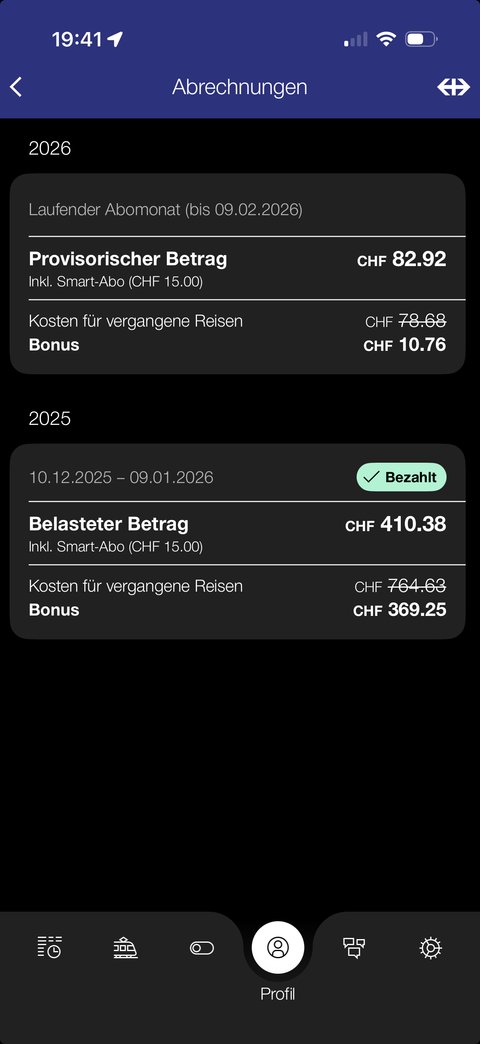
In my first month with MyRide, I was effectively charged 410.48 CHF. The pure travel costs would have amounted to 764.63 CHF. Thanks to the bonus system, 369.25 CHF were credited to me and deducted directly. For comparison: My previous 1st class GA Travelcard cost me around 560 CHF per month.
My mobility behavior did not change during this time. I traveled just as often, attended professional appointments, and also used public transport privately. Nevertheless, my effective mobility costs in the first month with MyRide were around 150 CHF lower than before.
Flexibility between 1st and 2nd class in everyday life
A major advantage of MyRide is the freedom to decide anew before every trip whether to travel in 1st or 2nd class. If I'm traveling early in the morning and the train is very full, I check into 1st class. If I travel back late in the evening and the train is almost empty, 2nd class is perfectly sufficient for me.
This flexibility fits my daily life much better than a fixed subscription. Especially in urban traffic or on short routes, a 1st class subscription is often irrelevant. Even in S-Bahns or regional trains, a fixed premium subscription quickly feels excessive. MyRide allows me to decide situationally without committing myself permanently.
Technical look at MyRide
From a technical perspective, MyRide is particularly exciting. The system is based entirely on check-in and check-out via a smartphone app. The app records the time, route, and means of transport used and correctly assigns these to the public transport network. In the background, the data is processed and used for billing.
In everyday life, this has worked very reliably so far. I had no incorrectly recorded trips, no double billings, and no technical failures. As someone who relies on functioning systems professionally, I look very closely here.
Exciting is also the approach that MyRide no longer relies on tariff zones or fixed routes, but on effective distance. This feels more modern and fits better into a digital infrastructure where usage is more important than ownership.
An open conclusion
MyRide is not purely a savings model and not just a solution for former GA owners. It can be interesting for frequent, occasional, and infrequent travelers, depending on personal mobility behavior. Those who travel rarely benefit from the simplicity without a subscription. Those who travel a lot can save through the bonus system. And those who want to travel flexibly gain freedom above all.
For me personally, MyRide is currently working very well. I am just as mobile as before, have more freedom of decision, and lower costs. Whether this remains so in the long term remains to be seen. But it already shows that alternative pricing models in Swiss public transport are not only possible but can be sensible.